
Nos bénévoles
STICK YOUR CHEST OUT PROUDLY. Refuel a thirsty runner. Stuff tax receipts. Hand out health education material. As one of our passionate and hard-working volunteers, you can connect with a joined-at-the-lung community of fellow concerned breathers. Whether you have minutes, hours, days or months to spare, we’ll do our best to match you with a job that suits your skills, interests and experience.
GET TO KNOW SOME OF OUR DEDICATED VOLUNTEERS:
An opportunity for personal growth: Bill Kilgour
For the past three years, Bill Kilgour has been a volunteer with the Ontario Lung Association at its provincial office in Toronto. Having experienced a major health issue involving brain surgery that affected his memory, Bill was drawn to the educational aspect of our organization and the opportunity it presented for personal growth.
“Although initially unfamiliar with this charity, as I worked alongside staff I quickly learned about its mission and its accomplishments,” said Bill.
The first task he was given was processing receipts. Then he moved on to data entry for donations and working on the Breathers United campaign. Other valuable insight was gained through volunteering with the Your Healthy
Home initiative, as well as being invited to work on the information booth at the Ontario Lung Association’s annual Better Breathing conference in downtown Toronto.
“These experiences have enhanced my education in many ways,” said Bill. “They have also given me the experience of working in an office with great people who understand my situation, which in turn has built up my confidence for the future.
“Thank you to everyone at the Ontario Lung Association.”
Distinguished leadership: Neil Johnston
As a registered respiratory therapist and a long-time volunteer for the Lung Association, Neil Johnston has made significant contributions to lung health.
Neil began his lengthy volunteer work when he joined the Manitoba Lung Association as a volunteer committee member in 1993. He became a member of their board in 2000. In 2010, he became Board chair and a representative of the Canadian Lung Association Board and its Finance Committee.
In 2013, Neil volunteered to become the Chair of the National Research Steering Committee and was elected as treasurer of the Canadian Lung Association Board.
During his two decades of volunteering, he has been instrumental in moving the national research agenda forward and has spent countless hours spearheading the soon-to-be-launched research fundraising campaign and providing direction to the boards and senior management of both the Manitoba and Canadian Lung Associations.
“Neil always applies his sense of humor, excellent communications skills, experience and insight to the tasks that are required of him. Neil always makes himself available to provincial staff to help with networking and to provide direction and advice,” says Deborah Harri, chair of the Manitoba Lung Association.
For his distinguished leadership and outstanding commitment to advance the mission of the Lung Association, Neil received an Honorary Life Membership Award in June 2014.
“I volunteer for the Lung Association because of its important roles in maximizing the lung health of people, their families and neighbors” says Neil, who is the Winnipeg Regional Health Authority’s Regional Director and the Health Sciences Centre Winnipeg’s site Director of Respiratory Therapy.
Pleins feux sur les donateurs et les collecteurs de fonds
Donating breath in the name of love

Weddings are an occasion to celebrate love and friendship. But in the case of Vanessa and Chris, it was also an opportunity to celebrate life and breath.
Their February 25th wedding was the culmination of five years of friendship and dating.
“Once we actually took the time to get to know one another, we were inseparable,” says Vanessa.
As Vanessa looks back, she says her wedding was magical and close to perfect. The most breathtaking moment of the day, she says, was being surrounded by friends and family that took the time to celebrate their love. Perhaps the one thing that added an emotional hurdle to her day was that her father wasn’t there to walk her down the aisle. This is because Vanessa’s father died of lung cancer.
“I truly felt his presence and managed to stay strong for the entire day.”
Sadly, Vanessa’s was not the only family that was incomplete at the wedding. Chris’s grandfather also died of lung cancer. This shared history inspired the couple to do something a little different for their wedding guests.
Instead of wedding favours, the couple chose to make a donation to the Lung Association.
“It was so important to the both of us to donate the Lung Association, as we both lost someone incredibly dear to us,” Vanessa says, adding “this disease obviously hit home for the both of us and we wanted to donate in memory of my father and Christopher’s grandfather. We think any research that could help even the healthiest person with preventative measures is very important…The sooner we are underway with appropriate research; the sooner we’ll have a solution or a cure.”
But sadly, many people won’t truly appreciate the importance of breath until it’s taken away from them or their loved ones. As Vanessa explains, a donation to The Lung Association should not always be a response to a tragedy.
“I think there was a common misconception that smoking is the leading cause of disease in the lungs and many people won’t donate because of this,” she speaks of the unfortunate stigma. “I think what people are starting to realize now is that lung health research and prevention covers all areas – whether it’s a family member going through chemotherapy or radiation due to lung care, or a child with a very serious and life-threatening asthma.”
Vanessa’s wish for the impact of their donation was plain and simple: they want it to help save lives by putting air back into the lungs of Canadians.
Ian Fish – Mountain Climber, Fundraiser extraordinaire
I have Stage 2 COPD and have struggled with lung disease since I was 5 years old. In 2010, I was 240 pounds and could barely walk up a short flight of stairs without becoming breathless.
Today, driven by a focus on fitness and nutrition, I am 45 pounds lighter, I still have only 60% of my predicted lung capacity for a male my age and size, and I climb mountains. Big mountains. In 2012, I climbed Mt. Athabasca, one of the more beautiful mountains in the Canadian Rockies. In 2013, I again climbed Mt. Athabasca via the technically and endurance demanding North Face East Ridge Bypass route.
In September 2014, I will climb Mt. Robson, the most prominent mountain in North America’s Rocky Mountain range and also the highest point in the Canadian Rockies. The very sight of Mt. Robson is enough to knock you off your feet. Not only do its sheer and intimidating faces dominate everything around it, the pyramid shaped monolith is plastered with jagged ice, carved by severe winds into the infamous and gigantic “gargoyles” that guard the main summit block. On top of that, its lower flanks are draped with gnarly and dramatic glaciers riddled with crevasses and ice-fall. There is no easy way up this mountain, which is why it is one of Canada’s most prized and least attempted summits in North America.
While climbing Mt. Robson is a personal goal, I also believe in helping the Lung Disease community. I have a huge belief in the power of fitness and nutrition to improve the quality of life for people suffering with Lung Disease. I am using my climb as an opportunity to work with the Lung Association to not only raise awareness of the importance of fitness and nutrition, but also to raise money to support a pilot fitness and nutrition program targeting youth with lung disease.
Ian has raised more than $16,000 for the Manitoba Lung Association.
Tim Woodcock, un fidèle supporteur
Tim Woodcock has been a loyal supporter of The Manitoba Lung Association for many years. 2013 was no exception when he donated 100% of the proceeds from Woodcock Cycle Works annual Icebike event to The Manitoba Lung Association. Tim’s donation was a tribute to his father, Michael “One Lung Wonder” Woodcock. After having his lung removed at the yearly age of 30 years old Tim’s father learned to manage his condition and lived to be 83 years old.
Tim est également affecté par l’asthme. Il se passionne pour l’éducation de la communauté des cyclistes et des athlètes, quant à l’importance de la santé pulmonaire en lien avec l’activité physique.
La collecte de fonds pour l’Association pulmonaire du Manitoba lui tient à cœur, car elle permet à un plus grand nombre de Manitobains d’être éduqués et de retrouver la santé. Tim a participé aux Championnats mondiaux de cyclisme, en Autriche. Il a attribué son succès en tant que cycliste au fait qu’il contrôle son asthme et qu’il ne laisse pas sa maladie le contrôler.
Des gens qui respirent mieux
Voici quelques témoignages de personnes qui respirent mieux grâce à l’aide de l’Association pulmonaire.
Retrouver sa liberté : David Wheadon
Après une double greffe de poumons réussie, David Wheadon peut désormais respirer mieux.
Ce mécanicien de chantier de 55 ans a reçu en 2002 un diagnostic d’emphysème — une maladie chronique à long terme qui endommage les minuscules sacs d’air à l’intérieur des poumons et rend la respiration difficile.
Over time the illness will get worse, as was the case for Wheadon who spent the last few years attached to oxygen bottles. His condition worsened in 2008 when he “collapsed at work.”
“I was on 10 litres of oxygen (a day) just to move, just to walk, just to do anything in daily living” said Wheadon.
Après sa chirurgie en février 2014, M. Wheadon a mis du temps à être à l’aise avec l’idée qu’il n’allait plus avoir besoin d’une bouteille d’oxygène à ses côtés 24 heures par jour, sept jours par semaine.
“Now, I don’t even miss it — there is no more oxygen bottles in my house,” said Wheadon. “I have my freedom back. I can do anything — I can go up and down stairs with no problems.”
Wheadon received some financial support from The Lung Association, Alberta & NWT’s Second Breath program during his long stay in Edmonton where his transplant took place.
Lung-transplant patients — many of whom come from all over Western Canada to Edmonton for the complicated surgeries — must stay in Alberta’s capital city for at least five months. Along with offering guidance to those patients, The Lung Association, Alberta & NWT offers some financial help for those patients with food, accommodation and fuel costs with funds raised from TLA’s generous supporters.
“They give you support just by talking to you,” said Wheadon about The Lung Association. “They know you’re there if you need to call.”
Dennis Woodford
Au début de 2011, Dennis Woodford s’est fait dire par ses médecins qu’il n’allait probablement pas vivre jusqu’à l’année suivante. Il s’était préparé au pire, mais il avait espoir de trouver un donneur de poumon. En avril 2011, Dennis a reçu un appel de son médecin, lui annonçant qu’on lui avait trouvé une paire de poumons. Il a subi une double greffe de poumons.
Dennis is a member of The Manitoba Lung Association’s Lung Transplant Support Group. The group meets once a month to lend to support for people who have either had a
lung transplant or are on the waiting list. Dennis credits the group for getting him through one of the most difficult times of his life.
Dennis et les membres du Groupe de soutien pour la greffe collaborent avec d’autres intervenants à militer pour le consentement présumé aux dons d’organes, au Manitoba.
Réduire les déclencheurs d’asthme en classe : Heather Crysdale
As a teacher, Heather Crysdale knows that asking for help is important. That’s why she sought out The Lung Association’s help to learn how to manage her asthma better.
Heather a travaillé avec Rosario Holmes, éducatrice certifiée dans le domaine de l’asthme pour l’Association pulmonaire à Ottawa, afin de mieux connaître ses médicaments contre l’asthme et d’apprendre à utiliser correctement ses inhalateurs, avec les bonnes techniques de respiration.
Rosario lui a expliqué comment utiliser un tube d’espacement avec son aérosol-doseur pour améliorer l’absorption du médicament, et comment garder ses inhalateurs propres.
“As a teacher of young children, I have since gone on to pass these same lessons about inhaler use and cleanliness to the students in my class who have asthma and to their parents,” explains Heather.
Rosario also discussed ways to make Heather’s home and work environments more asthma friendly. “After my visit, for example, I purchased new bedding to reduce the dust levels in my bedroom. In my classroom, I was able to reduce the levels of dust significantly, by purchasing large plastic bins with lids to contain my classroom teaching books and supplies. Instead of using chalk boards and chalk, the students and I now use dry erase boards and low-odour dry erase markers,” says Heather.
“I am happy to say that I have been symptom free for quite some time now. During the 2012-2013 school year, I didn’t take a single sick day and my asthma has been very well controlled.”
Une nouvelle paire de poumons : Joanne Cormier
Joanne Cormier, a double-lung transplant recipient from Willingdon, Alta., says her life has already changed for the better since receiving her new lungs. She’s grateful to her lung donor and to the Lung Association for providing her with much needed support.
She can now breathe easier. “There are no words to describe my thankfulness (to the lung donor’s family),”said Cormier. “What do you say to someone for that great of a gift? A thank you is just not enough.”
L’Association pulmonaire de l’Alberta et des Territoires du Nord-Ouest offre du soutien financier aux patients de l’extérieur et à leurs soignants qui, comme Mme Cormier, doivent passer de longs mois à Edmonton avant, pendant et après leur intervention chirurgicale.
“I was given a $1,000 grant, and the Lung Association gave me $600 to help pay for my rent in outpatient residence, and I was given $200 in food and $200 in gas so I can get back and forth,” said Cormier. “This took a weight off my shoulders.”
Depuis sa greffe salvatrice, Mme Cormier est soulagée de ne plus avoir à être attachée à une bombonne d’oxygène 24 heures sur 24, sept jours par semaine.
« Je me sens très bien — 100 % mieux qu’avant », note Mme Cormier, qui s’est battue quatre ans contre la maladie pulmonaire obstructive chronique (MPOC) avant sa chirurgie du 28 avril 2014.
COPD is an illness that slowly damages a patient’s airways — breathing tubes that carry air in and out of their lungs. The illness causes those airways to swell along with causing mucus to block those airways. COPD also damages tiny air sacs at the tips of those airways, which makes breathing extremely difficult.
Cette mère de deux enfants explique que sa maladie a été causée par ses plus de 30 ans de métier en tant que serveuse et barmaid dans un bar rempli de fumée.
Cormier says she is looking forward to playing darts again — something that she couldn’t do before the surgery — along with doing some gardening.
Non-fumeuse depuis 21 ans grâce à l’Association pulmonaire : Karen Flanagan-McCarthy
I couldn’t have quit smoking without the ‘Countdown’ course I took at The Lung Association 21 years ago. And I am quite sure becoming a non-smoker has added years to my life. It certainly has added life to my years!
I smoked for 18 years. I got to the point where I was smoking a pack a day. My ‘ah-hah’ moment, when I knew I had to quit smoking, came when I realized I couldn’t climb two flights of stairs without taking a break. It was literally a ‘breathless’ moment at the start of each workday. I remember thinking, ‘I’m not going to make it to the age of 40 at this rate!’
It wasn’t easy to quit. I was working as a radio reporter. We couldn’t smoke in the studio anymore, but we could have a quick smoke in the smoking room just across the hall. Smoking was part of that news reporter culture. I couldn’t imagine myself as a ‘non-smoker’. Today, I can’t imagine that I ever smoked.
Le cours que j’ai suivi était formidable. J’ai apprécié le soutien du groupe et celui de Joyce MacPhee, une autre participante qui venait d’arrêter de fumer et que j’ai rencontrée au cours. Nous pouvions nous téléphoner entre les rencontres, quand l’envie nous prenait de fumer.
Today, we’re still friends and still non-smokers. So thanks to the Lung Association for the very large role it has played my life.
A post-script to my story: After I’d been smoke-free for a year, the Lung Association in Ottawa approached me and asked whether I would like to lead the same course I had taken. I was. And I did, for two or three years. It helped me stay a ‘quitter’ and I loved helping other people make the same positive change in their lives.
Larry Graham
Being a double lung recipient as of Oct. 21, 2012 and having just returned from the Canadian Transplant Games in Moncton, New Brunswick, on July 7-12, 2014 as a participant, I must give a big thank you to The Lung Association that made it all possible. I wouldn’t have come this far without them. The Lung Association literally saved my life.
All this I know for sure, that I couldn’t have done without all the education, training and exercise I had from the Lung Association’s Program under the direction of the Respiratory Therapist, Rosario Holmes. She actually saved my life by calling the surgeon’s nurse to tell her that I was getting extremely worse when my lung capacity was down to 12%. She called on a Tuesday and I was put on the emergency list and by that Sunday on the same week I received my miracle.
Growing up with chronic asthma with severe allergies and then having COPD, I wasn’t very strong or healthy when I joined the pulmonary maintenance exercise program at the Lung Association.
Ce programme m’a aidé à surmonter de grands obstacles. L’inhalothérapeute Rosario Holmes m’a appris à composer avec ma maladie, la maladie pulmonaire obstructive chronique, par l’éducation et l’exercice. C’était une monitrice sévère. J’ai beaucoup appris et ça a rapporté.
On m’a appris à respirer correctement, avec les épaules baissées, à utiliser adéquatement mes inhalateurs avec le tube d’espacement, et à doser mes efforts. Depuis mon admission au programme il y a 15 ans, les exercices quotidiens m’ont permis de maintenir ma santé et ma respiration et d’éviter l’hôpital.
Chaque jour, je faisais les exercices sur chaise avec divers poids libres, les étirements et l’entraînement en force pour le haut et le bas du corps, qui aidaient spécifiquement mes muscles respiratoires, ma résistance et mon endurance.
J’utilisais surtout le tapis roulant et le vélo stationnaire, jusqu’à ce qu’ils se procurent un appareil pour flexion des jambes qui a considérablement amélioré la musculature de mes jambes pour m’aider à garder mon équilibre et à me donner la force de transporter ma bombonne d’oxygène au cours des cinq dernières années.
Même si mes poumons et ma capacité pulmonaire se détérioraient, le programme m’a gardé suffisamment motivé et stable pour aller de l’avant et demander une greffe de poumons.
La simple idée d’avoir une deuxième chance, de recommencer à zéro et de pouvoir mieux respirer m’incitait à travailler encore plus fort.
En août 2010, je suis allé faire les neuf jours de tests pour déterminer si j’étais admissible à une greffe de poumons. On m’a fait passer toutes sortes de tests comme un échocardiogramme, un test de la fonction pulmonaire, des ultrasons de l’estomac et du cœur, un test de densité des os, et plus encore.
Les résultats étaient bons et j’ai été accepté pour une greffe de poumons. Tous mes organes étaient fonctionnels sauf mes poumons.
Le programme d’exercice de l’Association pulmonaire a fait en sorte que mes problèmes pulmonaires n’affectent pas mon cœur, même si mon état se détériorait et que ma capacité pulmonaire diminuait.
Une autre chose que nous avons comprise est que je devais entraîner mes jambes et développer ma force pour récupérer plus vite après mon éventuelle greffe.
Photo: Larry Graham with Rosario Holmes, a certified respiratory educator with the Ontario Lung Association.
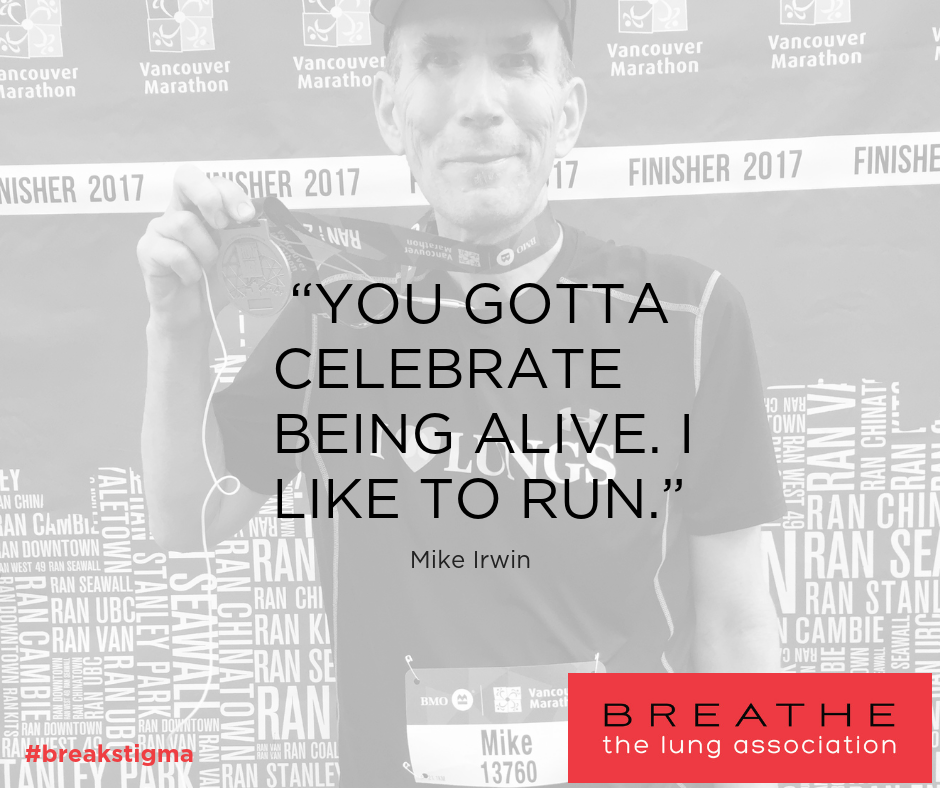
Running for the love of lungs – Mike Irwin
When Mike Irwin was 49 years old, he received shocking news that explained the difficulties he had breathing. His diagnosis of bronchiestasis in 2010 started a 5-year journey of lost breath, doctors’ visits and surgeries.
“I just kept getting sicker and sicker and it was a struggle to get through the day. And nothing seemed to work. I had more than one bronchoscopy,” Mike said. Two years after his diagnosis, Mike had his first procedure.
 Bronchiestasis is a disease that causes airways to widen and stretch out. In some places the airways are so stretched out they form little pockets. Germs, dust and mucus collect in these pockets and get stuck.
In 2015, things got worse for Mike. On October 6, 2015, due to some complications, he had to be “medevaced” to Vancouver. The infection that was discovered meant that he had to have the middle lobe of his right lung removed. But once his stitches were out, he laced up his running shoes.
“I started walking at first to keep active and kept my lungs functioning.”
In 2016, Mike completed his first marathon in Vancouver, followed by two more half-marathons.
Since then, has run 10 half-marathons and 4 full marathons within 2 years.
While his own diagnosis might have been the wake-up call, it was his father’s death that pushed him further along the track.
“My dad died from lung cancer in 2012. And I made him a promise that I was going to do a half-marathon.”
“I decided to run to raise awareness about lung disease.”
Collecting ribbons, medals and accolades, Mike can’t help but feel grateful.
“There’s not a day goes by that I don’t realize how lucky I am. Everything fell into place: The right diagnosis, the right surgeon and that’s why I’m able to do what I do.”
To recognize and show his gratitude for being able to breathe, he runs half-marathon every year to celebrate his birthday.
“You gotta celebrate being alive. I like to run.”
Wayne Krentz
Wayne Krentz est conducteur de chariot élévateur pour Monarch Industries, une entreprise qui offre à ses employés des tests de dépistage en santé pulmonaire depuis plus de 20 ans.
In October 2013 The Manitoba Lung Association’s Occupational Lung Health survey team administered screening tests to Wayne and other employees at Monarch. Wayne’s tests detected a tumor in his lungs that required immediate surgery.
Wayne credits Monarch Industries and The Manitoba Lung Association’s lung health screening program for providing the detection that saved his life.